Ellen Wilmott was born in Heston, Hounslow, UK August 19, 1858, and then moved with her family to Warley Place in Great Warley, Essex.
She made a name for herself in her youth because of gardening, or rather, designing her family’s gardens at Warley Place.
She became independently wealthy when her godmother, Countess Helen Tasker, died in 1888 leaving her a ton of money. The story is that the countess was frightened to death after a burglary. This probably seems reasonable if you’re from the 1800s and think women are prone to things like “the vapors” and other nasty women’s diseases. What might be more likely is that she committed suicide by jumping off a terrace. Some say that was improbable because Tasker was given a full Catholic burial which isn’t done for suicides. But a church might want to forgo the shaming bit if say the person who committed suicide had bankrolled the nunnery, hospitals, schools, etc., and was made a countess by the pope. Anyway, it’s all speculation. The end result is she died and Ellen Wilmott was stupid rich.
Wilmott went on a spending spree buying estates in France and Italy and then proceeded to spend copious amounts of money on plants and gardeners for all three estates.
She began sending people on plant-hunting expeditions probably because she ran out of readily available plants in Europe. The expeditions were mostly in Asia. One of the hunters was famed explorer and expert sudan chair rider Earnest Henry Wilson.
She’s said to have employed over 100 gardeners and fired any that left a weed un-pulled. Wilmott apparently didn’t like the idea of women gardening but did hire them as household servants and was said to get paranoid and fire them every so often because she thought they were stealing her stuff.
By 1894 she was one of the first women to become a member of the Royal Horticulture. She’d have over 60 plants named for her not long after that.
By 1904 she was experiencing some financial problems and then her French chateaux burned down. A long-standing rumor is that just before WW1 she invested heavily in German railroads. Some historians and writers give Wilmot the benefit of the doubt about this. There isn’t real proof she made a really stupid investment like putting money into railroads being built by a country hell-bent on invading Belgium, however, it doesn’t seem too far off. She blew money on plants and stupid things like a small cabin in Switzerland that Napoleon may have stayed in one time. She had the whole thing dismantled and shipped from the Alps to Warley Place. Just saying, the frivolous mega-rich of reality tv didn’t have shit on Ellen Willmott.
As time wore on she seemed to get more weird. Or maybe perhaps dwindling wealth made people notice it more. She was known to drop the seeds from a white/silver Sea Holly in other people’s gardens. They eventually named that strain after her calling it Miss Wilmott’s Ghost.
In between selling off her Italian and French properties, most of her possessions, and driving away her underpaid maid, she’d make time to set booby traps in her daffodil beds that involved trip wires and a gun. She may have had more than one gun because they say at some point she started carrying one with her everywhere. She probably needed the gun to protect a tulip bulb or a precious ball of tin foil that she probably carried around…probably in one of several bags she toted as she cursed at invisible servants for stealing her knick knaks… Probably.
She was accused and arrested for stealing a scarf at a shop in London in 1928. The account is that she bought the scarf but the receipt was misplaced. Despite her dried-up wealth and nutty behavior she still had connections in high places, or the highest place. Her one phone call was to Queen Mary.
Ellen Wilmott died in 1934 at the age of 76. Her family estate, Warley Place, was beyond disrepair and demolished within a few years of her death.
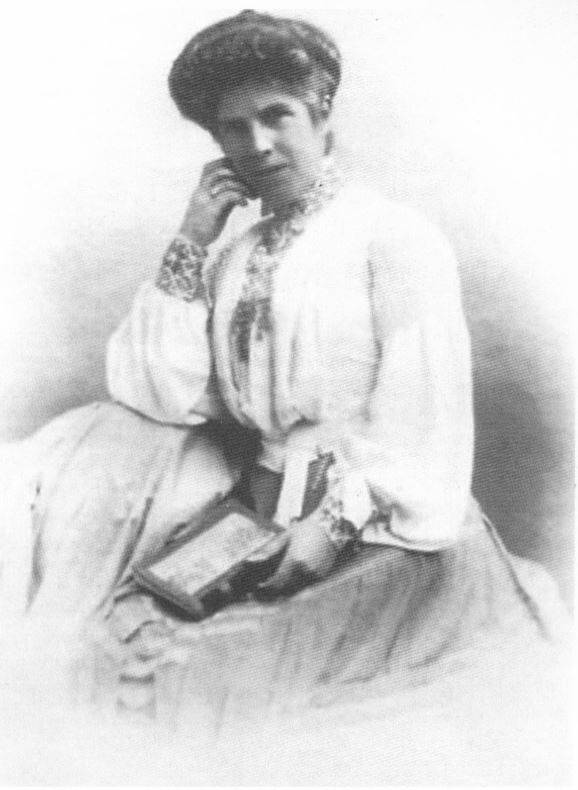
Image: Ceratostigma willmottianum, circa 1914. Public Domain.
Ellen Willmott, 1907. Public Domain.
Brown, Jane (11 September 1999). “The Essay: Miss Willmott’s Ghost”. The Independent.
Audrey Le Lièvre Miss Willmott of Warley Place: Her Life and Her Gardens. London: Faber and Faber. 2012
Sewell, Pauka. “Miss Ellen Wilmott of Warley Place, Essex, Eminent Gardener, Horticulturalist, and Garden Photographer.” Garden History, vol. 42, no. 1, 2014, pp. 89–105., www.jstor.org/Accessed 25 Feb. 2021.